
AI built me a World Cup wall chart. Will it replace me? No
Howie ·
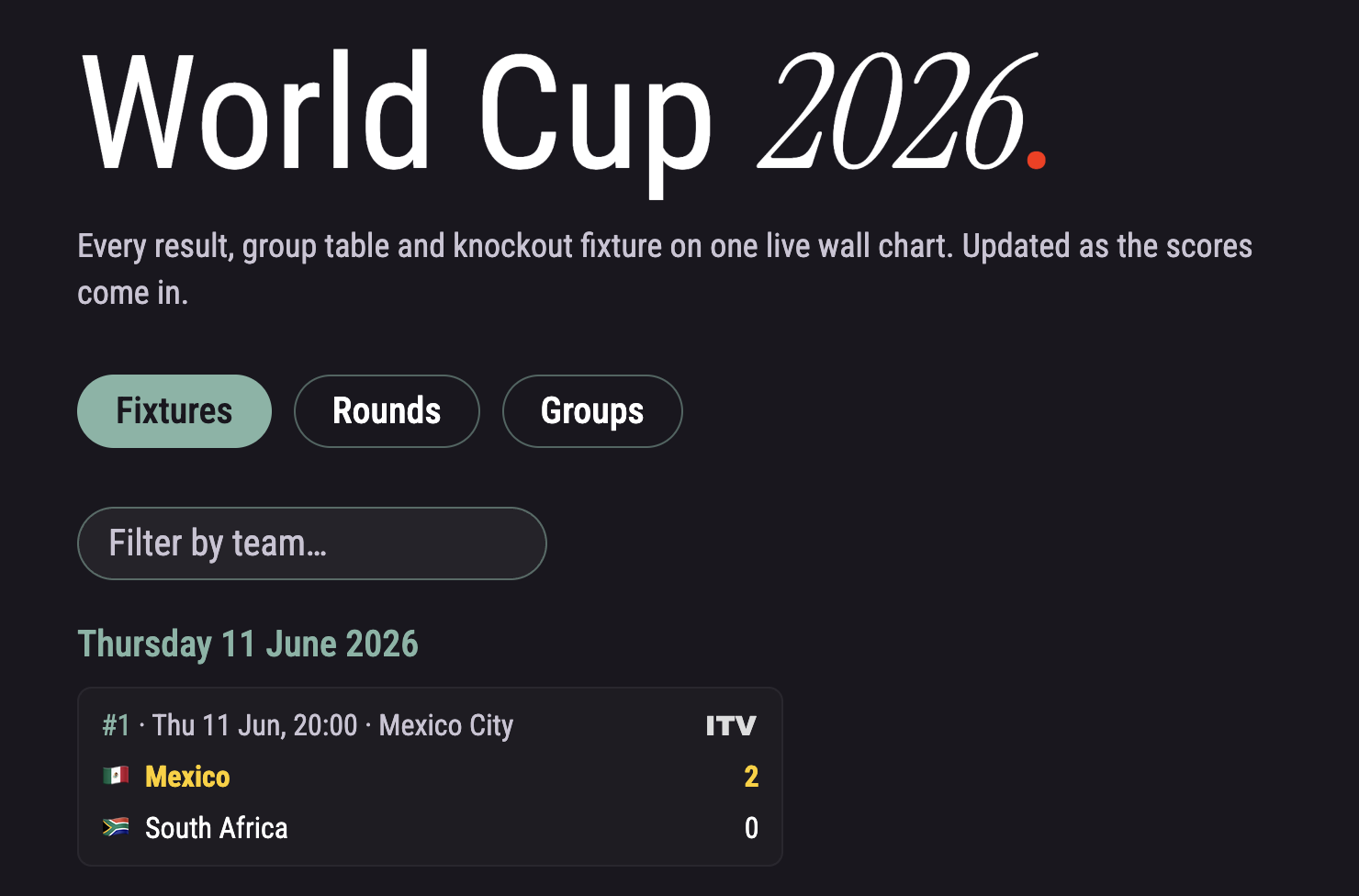
I've been trying to find an online World Cup wall chart. Every one I've found requires printing out. I don't have the wall space, but I do have a big computer monitor.
So that became my Friday afternoon project – getting Claude Code to build an online World Cup wall chart. A few hours later I had what I wanted, and more. I had a searchable fixture list including TV channels, plus a mobile-friendly page.
I'd decided to host it on my website. Claude picked up my front-end design system, it understood my back-end framework, and it made the kind of pragmatic calls I'd expect from a senior developer working with me. It is quite impressive what Claude can code given the right information.
Judge the results for yourself.
Why it worked so well
There's a famous marketing phrase that Content is King; well in this instance, Context is King.
I didn't start with a blank page. I explained what I wanted and asked the model how it would build it for my site. Because it could read my codebase, it planned all the changes required before writing a line of code, and it prompted me for direction when there were options to explore. The conclusions that it came to were:
The site runs on Django with a database, so the data, groups and results could be modelled and stored in the database.
Django ships with a ready-made admin panel, so there was already a way to enter results.
There's a caching framework in place, so the pages could be cached, meaning fast response times.
There's a task scheduler available, so scores could be pulled in from an API periodically.
The site design is responsive, so the model knew it had to work on a phone as well as a monitor.
The site uses a CSS framework, so it could reuse the utility classes already there.
There's a design system with brand fonts and colours, so it used these in its design.
With all of that to hand, it got me about 90% of the way there on the first attempt, and it made sure the page was accessible and optimised for SEO. We even had a back-and-forth about which APIs could supply match results for free and how often to refresh them. The sort of conversation I'd have with a co-developer across the desk.
Where it still needed my input
There were a few things it didn't think of on its own, the kind of details a non-technical brief would miss. I wanted a custom image for when the page gets shared on social media; easy, once I asked. There was a button with a tappable area too small for use on a mobile; it knew the fix once I pointed it out. I needed to prompt it to make the page installable as Progressive Web App (PWA) on a phone. Once I did so, it worked out how to create an icon using the command-line tools available on my laptop.
We made some improvements to a dropdown, and improved scrollbar styles. All things I know can be done; all things I know how to do. Small things, but they're the difference between "works" and "finished".
I didn't write a line of code. But I reviewed what was written.
Is it as good as a development team or agency?
What came together in an afternoon is the sort of thing BBC Sport would put months into. But that's not a fair comparison as their site has millions of visitors and mine will have a few dozen. The page has not been user tested or device tested. I'm sure there are some issues. The content will only be online for a few weeks, so I'm not overly worried.
If this was built for a client, it would have had much more TLC, more testing, feedback, iterations, time and inevitably cost.
Should I be worried that AI will make me dispensible?
No. Here's why. I'm a developer who knows what I expect the model to produce, including the tests, and I know what to look for that it might have missed. Without my guidance you get a very different result.
Imagine a client or a manager decides they'll just do this themselves. They're starting from a blank canvas, asking the model to build a complex web page with nothing to anchor it. It's like asking a builder to put up a house with no plans. Compare that to what actually happened here. The model had decisions already baked into my codebase to learn from, and someone directing it who knew what good looked like. I can't picture the result being the same in the hands of someone non-technical, or someone less experienced.
There's a commercial question hanging over all of this too. It remains to be seen how affordable these tools stay as coding partners. I pay $100 a month for Claude Code. My metered bill for the past twelve days was $347. At the moment it's fun to experiment and see what the models can do. If prices rise, which I'm sure they will, those that think my services are dispensible, might perhaps think twice. If they're smart, they will let me decide if I can deliver quicker and cheaper for them by using an AI to assist.
Coding is the easy part
There's no denying it, a Large Language Model, such as Claude, is a genuinely good tool for writing code, and it's getting better and faster. But it isn't a replacement for an experienced developer. It does its best work when it's handed the right context, and most of that context comes from a well structured, mature codebase. It also comes from knowledge about the client – their business, their priorities, their constraints. That's a relationship built over time, not something you can prompt your way to.
Coding is the easy part. Building things that solve real problems is the hard part, and that's the part we aren't worried about at How.
Want to talk about how we could help your business streamline the way it works? Get in touch.
Come on England! ⚽